In many cases, you do not need a CRM straight away. You need a better follow up process first. When leads go cold, quotes do not get chased, customer conversations sit in too many places, and nobody knows what should happen next, the real problem is usually not software. The real problem is a lack of process.
A CRM can absolutely help. What it cannot do is create clarity on its own. If your business has no agreed way to handle enquiries, track next steps, or stay in touch with prospects and clients, a CRM will not magically fix that. It will simply give the same confusion a new place to live.
Why business owners start looking at CRMs
Most people do not start by wanting software. They start by feeling the strain of disorganisation.
The inbox feels messy. Enquiries come in from different places. One person gets a quick reply while another waits too long. A quote goes out, then no one follows it up. Existing clients hear from you when there is a task to do, but not always in a way that feels joined up or proactive.
At that point, a CRM sounds like the logical next step. It feels organised. It feels professional. It feels like the sort of thing a growing business should have.
Sometimes it is exactly the right move. Sometimes it is just a more expensive way of avoiding the real issue.
A CRM is a tool. Follow up is a process.
This is the distinction many small business owners miss.
A CRM stores information. It tracks activity. It helps you manage pipelines, reminders and customer records. In the right business, with the right setup, it can be incredibly useful.
Follow up is different. Follow up is the process behind the tool. It covers what happens after someone gets in touch, who replies, how quickly they reply, what gets sent next, when the quote gets chased, and how the relationship stays warm if the prospect is interested but not ready.
If you do not have that process nailed down, the CRM will not solve the problem for you.
What a CRM will not fix
A CRM will not decide how quickly your team should respond to new enquiries. It will not define who owns each stage of the customer journey. It will not create a quote chasing routine if no one has agreed one. It will not stop leads slipping away if everyone still relies on memory and good intentions.
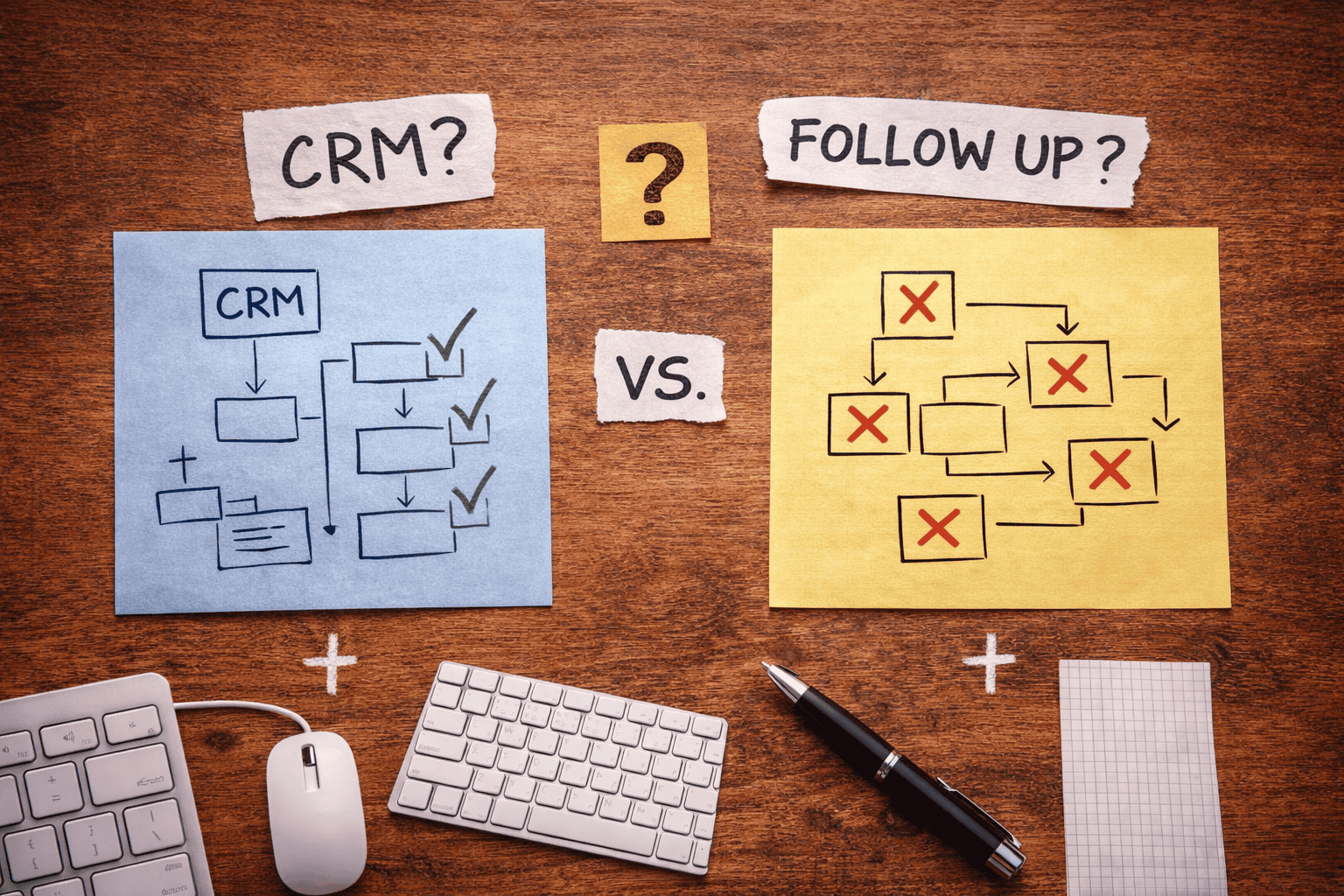
That is why some businesses say they tried a CRM and it did not work. In many cases, the CRM was not the issue. The business had not built a usable process around it.
This is uncomfortable to admit because buying software feels productive. It feels like action. Building process can feel slower and less exciting. In reality, process is what makes the tool useful.
The question to ask before buying anything
Before you compare platforms, prices and features, ask a simpler question.
Do we know exactly what should happen after someone enquires?
That one question tells you far more than any demo ever will.
If someone fills in a form, sends an email, messages on social media or gets referred to you, what happens next? Who replies? How quickly? What is the next step? If you send a quote, when do you follow up? If they are interested but not ready, how do you keep in touch? If a client goes quiet, how do you stay visible without becoming a nuisance?
When those answers are unclear, the issue is not usually the lack of a CRM. The issue is that the business has not defined the journey properly.
Signs the real problem is follow up
You can usually spot this quite quickly.
Sometimes leads do not get lost because you have nowhere to store them. They get lost because nobody moves them forward consistently.
In other cases, the business has no clear response standard. One person replies within the hour. Another replies when they get a chance. Everyone assumes someone else has picked it up.
Quote follow up is another common weak spot. A proposal gets sent, then the business waits and hopes the other person comes back. When they do not, it gets written off as lack of interest, even though better follow up might have changed the outcome.
The same pattern often shows up with existing customers. They hear from you when there is a task in front of you, but not in a way that feels steady, thoughtful or planned.
What to put in place before you buy a CRM
This part does not need to be complicated.
Start by mapping the stages a lead moves through in your business. Keep it simple and real. For example, that might be enquiry received, first reply sent, call booked, quote sent, follow up due, won, lost, or not ready yet.
Then decide what should happen at each stage. Set a response standard for new enquiries. Decide when quotes should be chased. Agree what happens to leads who are not ready now but may be ready later. Build in simple customer check ins so relationships do not go cold between transactions.
After that, keep everything in one visible place. For some businesses that will be a spreadsheet. For others it may be a shared tracker or board. The format matters less than the visibility. You need to see what is live, what is waiting, who owns it and what happens next.
That is a real system. It may be simple, but it works.
When a basic tracker is enough
Not every small business needs a full CRM.
If you have a manageable number of enquiries, a straightforward sales process and one or two people looking after it, a tracker may be all you need for now. In fact, it can often work better because it is easier to maintain and less likely to become another half finished system.
A simple process used consistently will almost always outperform a sophisticated platform used badly.
That matters because many small businesses buy complexity too early. They pay for features they do not need, then feel disappointed when the results do not match the promise.
When you probably are ready for a CRM
There does come a point where a CRM earns its place.
You are more likely to need one when leads come in from several places, more than one person handles sales or service, handovers are becoming messy, or manual tracking is taking too much time. You may also want reminders, automation, reporting or better visibility across the customer journey.
At that stage, a CRM can make a real difference. The key is that you are choosing it to support a process you already understand. You are not hoping it will invent the process for you.
That usually leads to a much better result. You can judge the CRM against your actual workflow. You can ignore flashy features you will never use. You can set it up around the way your business really works.
What happens when you buy a CRM too early
Buying too early can create more work, not less.
Setup takes time. Data needs cleaning. Stages need defining. People need to use it properly. If none of that groundwork is in place, the CRM can become another admin burden instead of a helpful system.
It can also become a quiet drain on money and momentum. You pay the monthly fee, but adoption stays patchy. The data becomes unreliable. The team works around it. Six months later, the business has a subscription it resents and a process it still has not fixed.
That is why timing matters.
So, do you need a CRM or not?
For many small businesses, the honest answer is not yet.
First, fix the follow up. Decide what should happen when someone enquires. Give each stage an owner. Put timeframes around replies and follow ups. Make the pipeline visible. Create a rhythm for quote chasing and customer contact.
Once that is working, the decision becomes much easier. If the process runs clearly but manual handling feels clunky, a CRM is probably the next step. If the process still feels vague, you are better off tightening that before you spend money on software.
In other words, process first. System second.
That approach is usually cheaper, clearer and far less frustrating than hoping a CRM will rescue a messy workflow.